
Tight Schedules
Tight schedules do not leave much room for mistakes. The fewer shoot days a production has, the more important prep, communication, experience, and clear priorities become.
The Problem
Reducing shoot days does not just make the production slightly harder. It puts pressure on every part of the shoot. The fewer days you have, the less room there is to recover from slow setups, company moves, weather delays, missing props, turnaround issues, or crew that needs too much hand-holding.
A thirty-day shoot can absorb problems very differently than an eight-day shoot. On a tight schedule, every delay lands harder because there is less or no time to make up for it later.
Why Tight Schedules Are Different
Tight schedules remove flexibility. There is less problem-solving time, less recovery time, fewer communication buffers, and less margin for error. Normal production problems become expensive very quickly.
A late first shot, a slow company move, a missing prop, or cast not being ready may be manageable on a longer shoot. On a tight schedule, the same delay can affect the rest of the day and sometimes the rest of the week.
- Fewer shoot days leave less room for mistakes
- Small delays become harder to recover from
- Weak communication creates delays
- Slow departments affect other departments
- Indecision costs more when the schedule is compressed
- Shooting priorities to tell the story need to be clear
The Five Pillars of a Tight Schedule
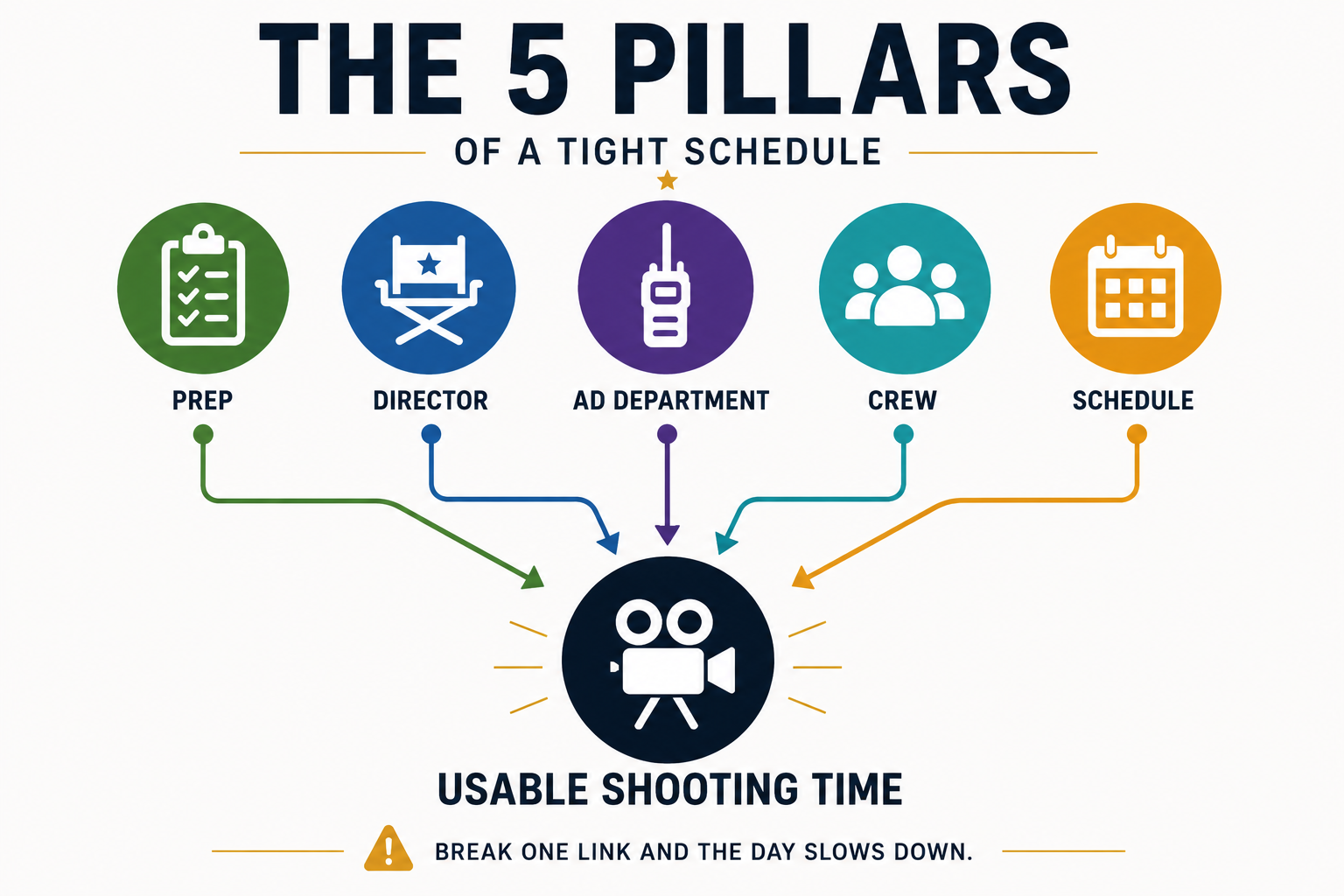
Tight schedules do not depend on one thing. They depend on prep, direction, AD communication, crew experience, and a schedule that matches reality.
The goal is not simply to make the day. The goal is to create as much usable shooting time as possible.
When one pillar weakens, usable shooting time starts disappearing.
Experience Buys Time
Tight schedules usually benefit from more experienced crew. Experienced crew members may cost more up front, but they often save time throughout the day because they know what matters, what can wait, and what needs to be solved before it becomes a problem.
Small time savings add up. A crew that saves ten minutes on several setups can recover hours across an entire shoot. On compressed schedules, that time can be the difference between properly covering the scene and rushing through it.
- Experienced crew need less supervision
- Strong department heads anticipate problems earlier
- Setups and turnarounds usually move faster
- Communication is cleaner between departments
- Fewer basic mistakes reach the shooting floor
- More of the day is spent on actual shooting
The Director Sets the Priorities
On a tight schedule, the director is one of the main drivers of whether the production can finish inside the allocated time window. A director who understands story priorities knows which moments deserve more time and which ideas may need to be simplified when the schedule gets tight.
The AD manages the pace, and the crew can execute the vision, but the director controls many of the creative choices that determine how heavy the day becomes. Too many unplanned shots, too many takes, unclear blocking, or discovering the scene on set can quickly turn a tight schedule into chaos.
- Know which scenes are important
- Make a realistic shot list
- Avoid changing direction once the full crew is waiting
- Understand what can be simplified without hurting the story
- Keep creative ambition connected to the available shooting time
- Make decisions early enough for departments to stay ahead
The AD Department Keeps the Day Going
On tight schedules, the AD department is the communication engine. The AD keeps departments in sync, watches the clock, and helps the set move seamlessly from one scene to the next without losing unnecessary time.
This becomes even more important when the page count is ambitious. A strong AD department helps the production understand what is still possible, what is starting to slip, and where decisions need to be made before it becomes a problem.
- Keep departments informed before problems hit the set
- Set the pace and keep the momentum going
- Help the director and producers make timely decisions
- Keep cast, background, departments, and locations moving together
- Prevent the set from turning into chaos
How Overtime Affects Tomorrow
Overly ambitious schedules often lead to overtime because the amount of work planned exceeds what can realistically be shot in a day.
Overtime does not only affect the day it happens. It slows the next day down before the crew even arrives. Tired crews move slower, communicate worse, make more mistakes, and stop anticipating as clearly.
Several long days in a row can create a set that looks busy but is actually becoming less efficient. Fatigue affects judgment, morale, safety, performances, and the speed of every department.
- Fatigued crews move slower
- Tired departments communicate less clearly
- Overtime increases the chance of mistakes
- Long days weaken decision-making
- Fatigue affects performances and crew morale
- Getting home safely after wrap is part of production safety
Food, Morale & Pace
Food is not just a comfort item. It affects the pace of the day. Drivers, production, G&E, camera, and other departments may start before official crew call. If those people go too long without food, the day starts with low energy and low patience.
- Breakfast matters when departments start before crew call
- Lunch affects the second half of the day
- Craft service keeps energy from dropping between meals
- A respected crew is more willing to help solve problems
Slow Is Smooth, and Smooth Is Fast
On tight schedules, some productions mistake panic for pace. Yelling, rushing, and constant urgency may look like speed, but it often creates more confusion, more mistakes, more resets, and more lost time.
“Slow is smooth, and smooth is fast” does not mean the crew should move slowly. It means the production should move clearly. Calm decisions, clean communication, prepared departments, and realistic setups usually move faster than chaos.
- Calm leadership helps departments stay focused
- Clear communication prevents resets and confusion
- Decisive choices keep the set from stalling
- Organized crews move faster than panicked crews
- Smooth departments stay ahead instead of chasing the day
- Operational calm protects creative quality
Protect the Scenes That Matter Most
Tight schedules force prioritization. Not every shot, scene, or piece of coverage contributes equally to the finished film. Strong productions identify what the audience absolutely needs to understand the story and protect those moments first.
A major character introduction, an emotional turning point, or a scene that advances the story may deserve more time and coverage. An insert, a transition scene, an establishing shot, or a piece of coverage that adds little new information may be simplified if production is falling behind. The goal is not to shoot everything exactly as planned. The goal is to protect the moments the audience will actually remember.
- Protect scenes with high story value
- Identify complex scenes before the shoot day
- Do not spend the best part of the day on low-priority coverage
- Simplify shots that do not add enough value
- Make sure the schedule supports the creative priorities
Tight schedules are rarely saved by working harder. They are saved by better prep, better priorities, and better decisions.
How important is this scene for the story and how much time should we spend on it?