
Protecting Creative Energy
Every shoot day brings together resources that cost real money: crew, cast, locations, equipment, vehicles, permits, and production support. Once the day begins, those resources are being spent whether the camera is rolling or not. The goal is to create as much shooting time as possible.
The Camera Creates the Value
A production does not create value because people are standing on set. It creates value when scenes are being shot and the camera is capturing material that can actually end up in the final project.
That does not mean the camera should roll every second. Blocking, lighting, rehearsals, resets, safety, and actor preparation all matter. But the whole production exists to protect the time where creative work is actually being captured.
Every Non-Shooting Minute Still Costs Money
When the camera is not rolling, the production is still spending money. Crew is still on the clock. Cast is still waiting. The location is still booked. Gear is still rented. Trucks are still parked.
Some waiting is necessary. Some prep is valuable. But unnecessary waiting is one of the fastest ways to waste a production day. The budget does not pause just because the set is not ready.
- Crew costs continue whether the camera is rolling or not
- Locations are paid for by the day, not by the shot
- Gear rentals do not become cheaper during delays
- Actors lose focus when they wait too long
- Scenes not shot today become problems tomorrow
- The money is already being spent, even when nothing is being captured
The Goal Is Not Just To Make The Day
Making the day is important, but it is not the full goal. A production can make the day and still waste too much of it. It can technically finish the schedule while rushing performances, cutting coverage, exhausting the crew, or leaving the best version of the scene behind.
The better question is not only, “Did we finish?” The better question is, “How much of the day was spent shooting usable footage?”
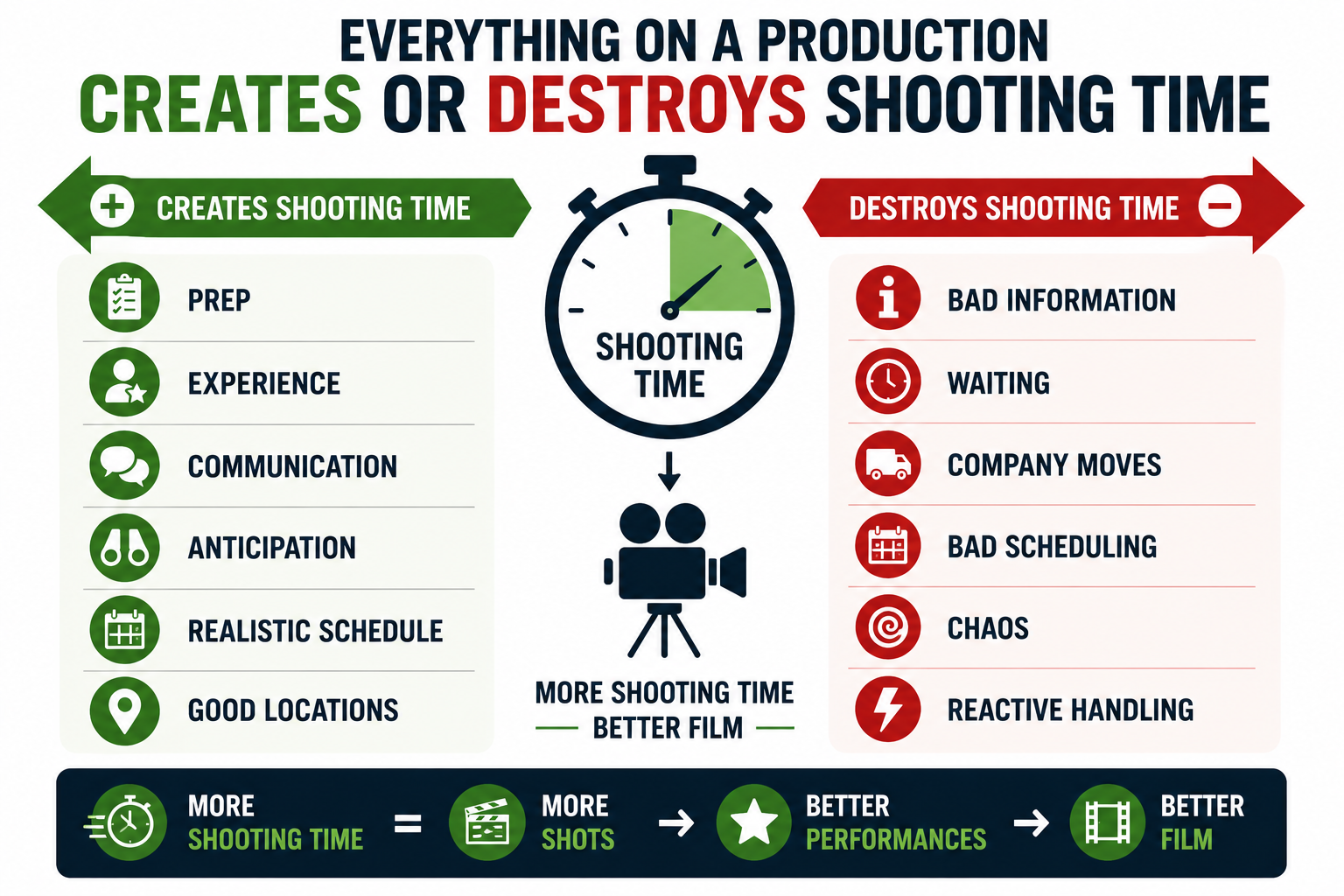
Every production decision either creates shooting time or takes it away.
- Did the director get enough time with the actors?
- Did the DP have enough time to light the image?
- Did departments stay ahead?
- Did the production spend the day shooting or fixing issues?
- Did the money turn into material that can end up on screen?
Good Prep Buys Shooting Time
Prep is not paperwork. Prep is how a production buys shooting time before the shoot day begins. Every clear schedule, accurate call sheet, finished breakdown, confirmed location, prepared prop, and realistic company move creates shooting time.
When prep is weak, the shoot day becomes the place where unanswered questions finally get answered. That is expensive. The most costly time to solve basic production problems is while the crew, cast, location, and gear are already being paid for.
Sometimes Spending More Creates More Shooting Time
The cheapest choice is not always the most budget-friendly choice. If an extra piece of gear, an additional truck, a stronger department head, a pre-rig day, or one more experienced crew member creates more shooting time, it may be worth the cost.
The right question is not only, “Can we afford this?” The better question is, “Will this help us shoot more material with the money we are already spending?”
- Additional gear can reduce reset time
- Experienced crew can prevent expensive delays
- Pre-rigging can speed up the setup time
- Better transportation planning can avoid wasted company moves
- Smart spending should create more shooting time
What Creates Shooting Time
Shooting time is created before and during the shoot day. Prep gives departments answers. Experience solves problems faster. Communication keeps people moving. Anticipation prevents small issues from becoming delays.
A realistic schedule and good locations can be worth more than they appear on paper. A location that is easy to access, easy to stage, and close to the next move can create hours of shooting time that would otherwise disappear.
- Prep
- Experience
- Communication
- Anticipation
- Realistic schedules
- Good locations
What Destroys Shooting Time
Shooting time disappears when the production becomes reactive. One delay creates another. Bad information forces departments to wait. A poorly planned company move eats part of the day. Bad scheduling pushes important scenes into the wrong part of the day. Chaos turns a plan into a series of emergencies.
The loss is not always obvious at first. It shows up as fewer shots, thinner coverage, weaker performances, tired decisions, missed moments, and scenes that technically get completed but never fully land.
- Bad information
- Waiting
- Company moves
- Bad scheduling
- Chaos
- Reactive handling
Film Production Always Changes
The goal is not to create a shoot where nothing changes. That is not how film production works. Weather changes. Actors get delayed. Locations shift. Gear problems happen. Scenes move. New information appears during the day.
Strong productions protect shooting time by absorbing change without turning the whole day into panic. When information moves quickly, departments can adjust. When communication breaks down, even small changes can destroy momentum.
- Change is normal
- Panic is expensive
- Departments need time to adjust before the problem hits the set
- A calm production can recover faster
- A reactive production loses shooting time one delay at a time
More Shooting Time Means More Choices
More shooting time does not only mean more footage. It means more choices. More shots. More coverage. More room for performance. More chances to improve a scene.
That is why shooting time is not just a schedule issue. It is a creative issue. When the production is focused on shooting time, the director, actors, DP, and crew have more room to make the work better.
- More shooting time creates more shots
- More shots create more options in editing
- More time with actors creates better performances
- Better use of the day creates better value from the budget
The Real Production Lesson
A shoot day is not valuable because it was full. It is valuable because it produced usable footage. The crew, cast, location, gear, and budget all exist to support that goal.
The best productions do not simply work harder. They protect the time that matters most. They use prep, communication, scheduling, experienced people, smart locations, and smart spending to create more time for the camera to capture the scenes.
The goal is not simply to make the day. The goal is to create as much shooting time as possible.
Do not judge every cost by what it adds to the budget. Judge it by whether it creates more shooting time.
Are we spending this shoot day shooting, or are we paying people to wait?