
Cheap. Fast. Good. Pick Two.
Every production is a tradeoff between money, time, and quality.
The Problem
Every production wants to be cheap, fast, and good. But on a real set, you rarely get all three at the same time.
Cheap and fast usually hurts quality. Fast and good usually costs more. Cheap and good usually needs more time. The mistake is pretending the tradeoff is not there.
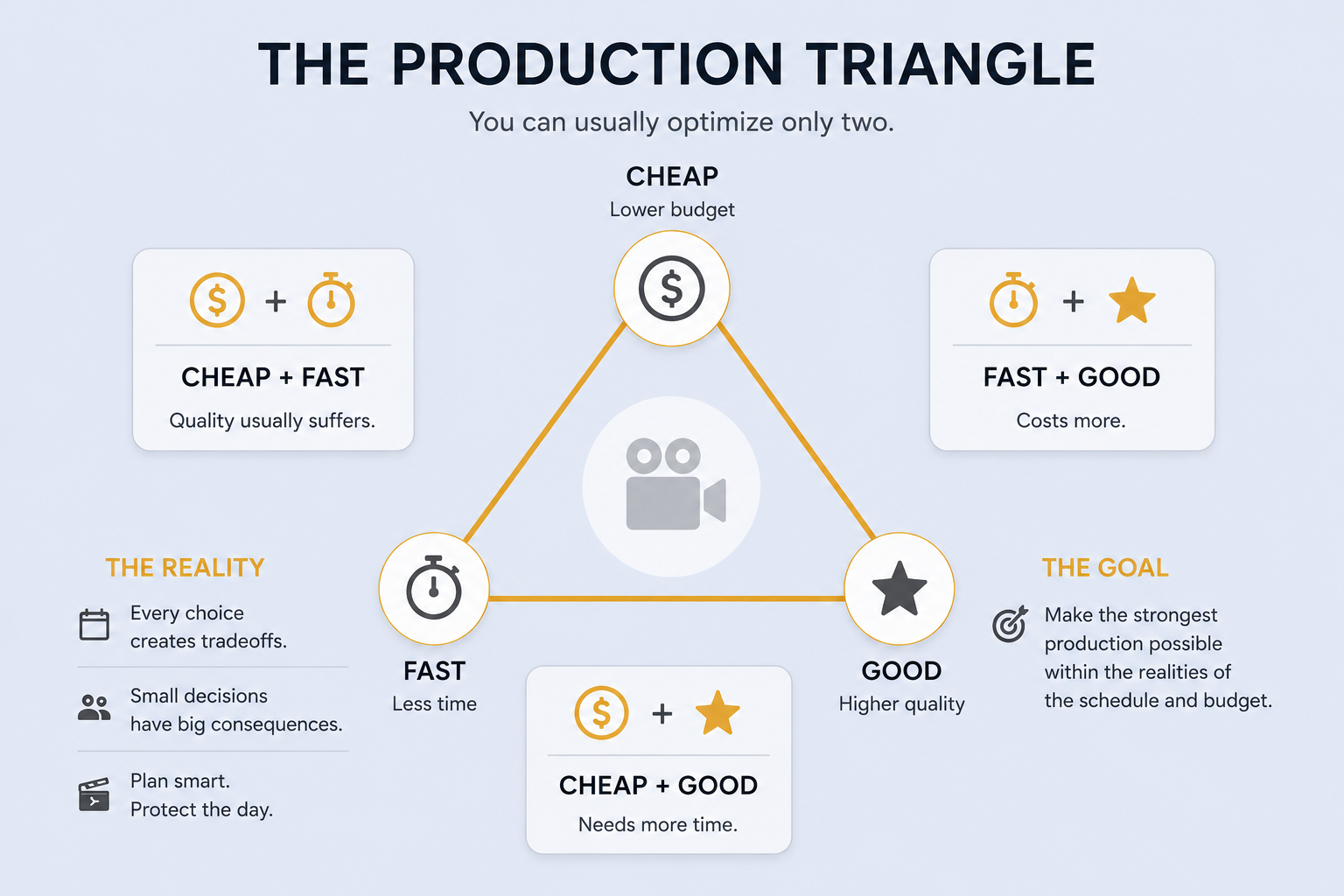
Understanding the Production Triangle
Cheap, fast, and good are always pulling against each other. A good producer does not ignore that. A good producer decides where the production can afford to cut corners and where it cannot.
This applies to features, television, commercials, documentaries, verticals, and indie films. The scale changes. The production reality does not.
- Cheap and fast usually means less time for quality
- Fast and good usually means stronger crew, better prep, and more money
- Cheap and good usually means more shoot days or more prep time
- Tight schedules leave almost no room for mistakes
- Low rates can become expensive if the crew does not make the day
- Quality is paid for somewhere: prep, production, post, or delivery
Fast and Good Costs More
Productions that move fast and still maintain quality usually pay for it with preparation and experience. Fast and good is possible, but it is rarely cheap.
Strong department heads make decisions faster. Experienced crews need less explanation. A good 1st AD protects the day. A strong DP and Gaffer know how to move without turning every setup into a discussion. Production-friendly locations reduce company moves, load-in time, and confusion.
The production may spend more money up front, but it often gains more usable shooting time, better footage, fewer mistakes, and less overtime.
- Experienced crew solves problems before they slow down the day
- Better prep reduces confusion once everyone is on the clock
- Production-friendly locations save time every department can feel
- Reliable gear prevents technical downtime
- Clear leadership keeps the crew from losing momentum
Cheap and Good Takes Time
Cheap and good can work, but time becomes the thing you are spending. This is where many indie films, documentaries, and smaller productions live.
If the budget is limited but the quality still matters, the production usually needs more prep, more careful scheduling, fewer rushed setups, and sometimes more shoot days. You can make strong work with less money, but you cannot pretend the missing money has no effect.
Cheap and good works best when the production is honest about pace. It needs a plan that protects the important scenes, keeps the locations manageable, and avoids building a schedule that only works on paper.
- More prep can replace some money, but not all of it
- Smaller crews need realistic days and clear priorities
- Quality can still be achieved if the schedule allows for it
- Fewer resources mean fewer mistakes can be absorbed
- The production must know where quality cannot be compromised
Why Cheap Can Become Expensive
Low budget does not mean spending as little as possible everywhere. That is how productions fail, hit overtime, lose coverage, frustrate the crew, and end up paying for the same mistake twice.
The cheapest production is often not the one with the lowest rates. It is the one that avoids bad locations, weak prep, slow departments, missing gear, unclear communication, and preventable delays.
- Skipping walkies can cost more time than renting them
- No breakfast can create a slow, frustrated crew before the day starts
- No holding area means cast and background become hard to find
- No nearby restroom can turn a location into a production problem
- Bad parking and bad load-in slow every department down
- Inexperienced crew can create overtime faster than they save money
Where Smart Productions Spend
Smart productions do not spend money just to spend money. They spend where it creates the most value on screen. The real question is: what gives the production the most usable shooting time?
That can mean hiring a stronger 1st AD. Sometimes it means choosing the location that is easier to load into instead of the one that only looks better in photos. Sometimes it means paying for proper walkies, bathrooms, breakfast, craft service, or one extra crew member in the department that is slowing the production down.
- Experienced ADs keep the day moving
- Strong department heads reduce mistakes and delays
- Production-friendly locations save setup time
- Reliable gear prevents technical downtime
- Walkies keep the crew from hunting each other down by phone
- Good food keeps morale and pace from dropping
- Proper prep keeps the shoot day from becoming reactive
The Real Goal
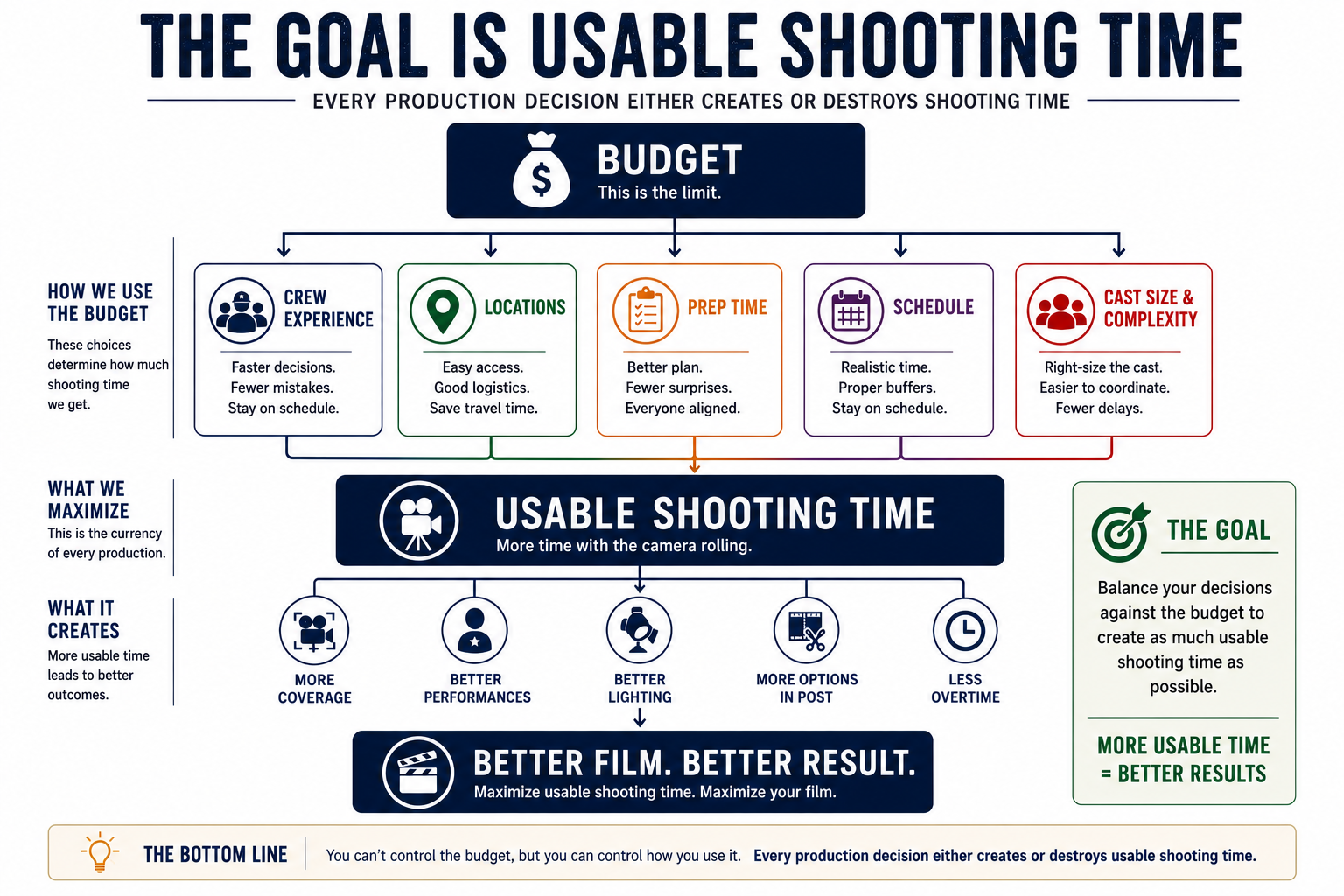
The goal is not to spend the most money. The goal is to create the most usable shooting time from the time, crew, locations, and budget you actually have.
Every decision made in prep and production either creates shooting time or takes it away. Experienced crew, better prep, realistic schedules, production-friendly locations, and manageable cast size all help keep the camera rolling.
More usable shooting time means more coverage, stronger performances, better visuals, more options in the edit, and less overtime.
Cheap, fast, and good is not just a saying. It is a decision you make every day in prep and every hour on set.
The productions that consistently deliver quality are usually not the ones with the biggest budgets. They are the ones that create the most usable shooting time from the budget they have.
The quality level of a project comes with a cost. Productions always pay for it somewhere — in prep, production, post, or delivery. You can’t cheat it.
What is needed to give the production the most usable shooting time that fits in the budget?