
The Real Cost of Company Moves
A company move is never just a drive. It breaks production momentum, eats valuable shooting time, and puts pressure on every scene that comes after it.
The Problem
Company moves are one of the biggest hidden schedule killers in production. On paper, they can look simple: finish one location, drive ten minutes, start again. On set, it is rarely that clean.
The drive is only one part of the move. The real cost is wrap out, loading trucks, parking, access, load-in, setup, cast movement, background movement, and getting the crew back into rhythm.
A 10-Minute Drive Is Not a 10-Minute Move
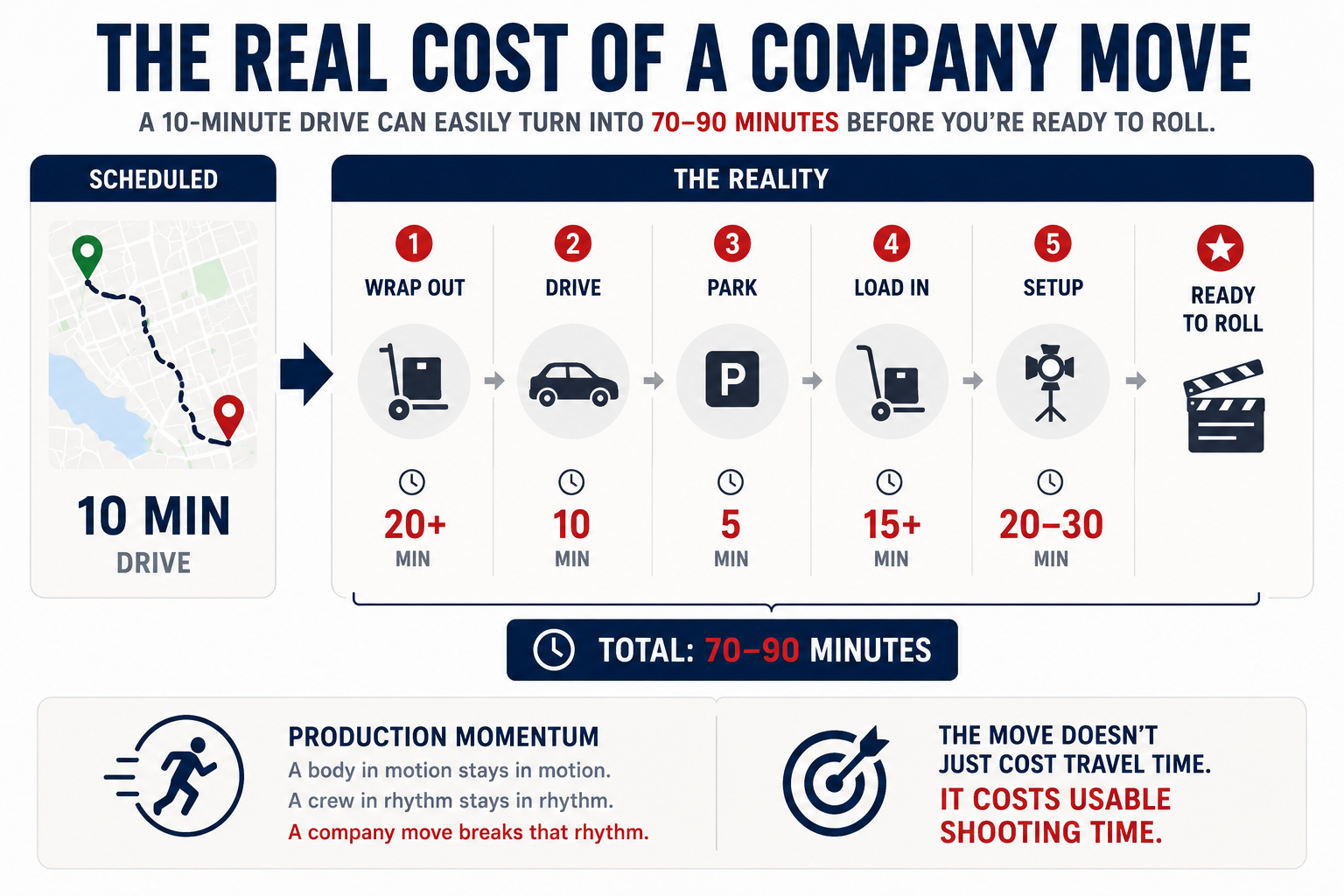
The mistake is treating a company move like a travel line on the schedule. A ten-minute drive can easily become seventy to ninety minutes before the crew is ready to roll again.
- Wrap out often takes twenty minutes or more
- The drive may only be ten minutes
- Load-in takes longer than people expect
- Setup has to happen before anyone is ready to shoot
- The crew has to find the rhythm again
The Real Cost of a Company Move
One company move can quietly take an hour or more out of the shooting day. That is why the move should not be judged by distance. It should be judged by how much usable shooting time it takes away.
The cleanest way to think about it is simple: what looks like a short move on the map can become a major reset for the entire production.
When You Move Matters
A company move is not only about distance. It is also about timing. A short move at the wrong time of day can become one of the worst decisions on the schedule.
Moving during rush hour is especially dangerous. The map may say ten minutes during prep, but at call time, lunch, school pickup, or evening rush hour, that same move can become thirty, forty-five, or sixty minutes before trucks, crew, cast, and background are all in the right place.
- Avoid company moves during morning and evening rush hour
- Check real traffic for the actual shoot day and move time
- Remember that trucks move slower than cars
- Account for parking, turns, loading zones, and street access
- Do not schedule the move only from a map estimate
- Move before traffic builds or after traffic clears when possible
The Shooting Time Tradeoff
Company moves are not just logistical decisions. They are creative decisions because they affect how much time the crew has to shoot the work properly.
If one move costs seventy-five minutes, that can mean losing setups, rushing a scene, dropping shots, shortening rehearsals, or pushing the hardest work into overtime.
- Less shooting time means fewer shots for the edit
- Lost time usually hurts the end of the day
- Cast and crew feel the pressure late in the day
- The move can decide what actually makes it into the movie
Production-Friendly Locations Matter
The best location is not always the prettiest location. A location can look great on camera and still be bad for production.
If there is no truck access, no parking, no clean load-in, no holding, no restrooms, or no place for departments to work, the location will slow production down. A slightly less flashy location that protects shooting time can give the production a better result.
- Easy truck access
- Clear load-in and wrap-out routes
- Nearby crew parking
- Cast and background holding
- Space for departments to work
- Restrooms close enough to avoid losing time
- Lunch space that does not create another move
- Safe crew movement through the location
Better Location vs Better Day
This is where producers, ADs, directors, and location managers have to be honest. Sometimes Location A looks better, but Location B is much more production friendly.
If Location B saves a company move, keeps trucks close, gives departments room to work, and gives another hour of shooting time, it may produce the better scene. Not because it looks better on its own, but because the crew has enough time to shoot it well.
- Can two scenes be staged in one location?
- Can blocking or art direction avoid a move?
- Does the location benefit the schedule?
- Can the crew work without fighting the space?
- Is the better-looking location worth the time it costs?
How Strong Productions Handle Moves
When a move is necessary, strong productions schedule the real move, not just the drive.
They group locations by geography, avoid traffic-heavy windows, reduce location changes, simplify transport, provide parking, plan load-in, check holding, and make sure every department knows what has to move and what can stay packed.
- Group locations by geography
- Avoid moves during rush hour whenever possible
- Check traffic at the actual move time, not just during prep
- Rewrite or stage scenes to reduce moves when possible
- Choose locations that are easy to load into
- Confirm truck access before the shoot day
- Pre-plan holding, restrooms, lunch, and department space
- Build the schedule around the true cost of the move
The Real Production Lesson
A company move is never free. It costs time, energy, coordination, momentum, and usable shooting time. The schedule may show a clean line between two locations, but the crew has to go through every step of that move.
Good producers, ADs, and location managers do not ask only whether a location looks good or whether the drive is short. They ask whether the production can actually function there, when the move happens, and whether the move is worth what it takes away from the day.
The best move is often the one you do not have to make.
Do not schedule a company move by drive time. Schedule it by the time it takes to be ready to roll again.
Do we really need to have a company move or can we alter some elements to shoot in the same location?