
Cheap Crew Can Be Expensive
Low rates can look good on for the budget, but the wrong crew can cost the production more through delays, overtime, mistakes, reshoots, post-production fixes, and results in reduced quality.
The Problem
One of the biggest production mistakes is hiring purely by the lowest rate. A cheaper crew member is not always a cheaper production decision.
Inexperienced or unreliable crew can slow the shoot down, fail to anticipate what is coming next, struggle to solve technical problems, damage gear or locations, communicate poorly, and ultimately push the production into overtime. Just as important, they can also create problems that follow the project into post: bad sound, soft focus, continuity issues, poor coverage, and fixes that cost time and money later.
Why Cheap Often Becomes Expensive
A crew member does not have to be expensive to be good, and a high rate does not automatically make someone strong or competent. But when a production hires only by rate, it can miss the real question: can this person keep up with the pace and quality the production needs?
The cheapest rate can become expensive when that person needs constant direction, lacks basic set experience, slows other departments down, or forces experienced crew to pick up the slack. The cost is not only overtime. The cost is also weaker execution, fewer takes, rushed decisions, and less time for the director, DP, and actors to complete the scenes.
Some of the cost also shows up after the shoot. Problems created on set often become post-production problems: extra sound repair, VFX cleanup, continuity fixes, missing shots, reshoots, or additional editorial time spent working around mistakes that could have been avoided during production.
The Crew Rate vs Real Production Cost
Day rates are only part of the equation. Overtime, delays, reshoots, and post-production fixes can quickly erase the savings of a cheaper crew. In many cases, a balanced crew with experienced people in key positions delivers the strongest overall value.
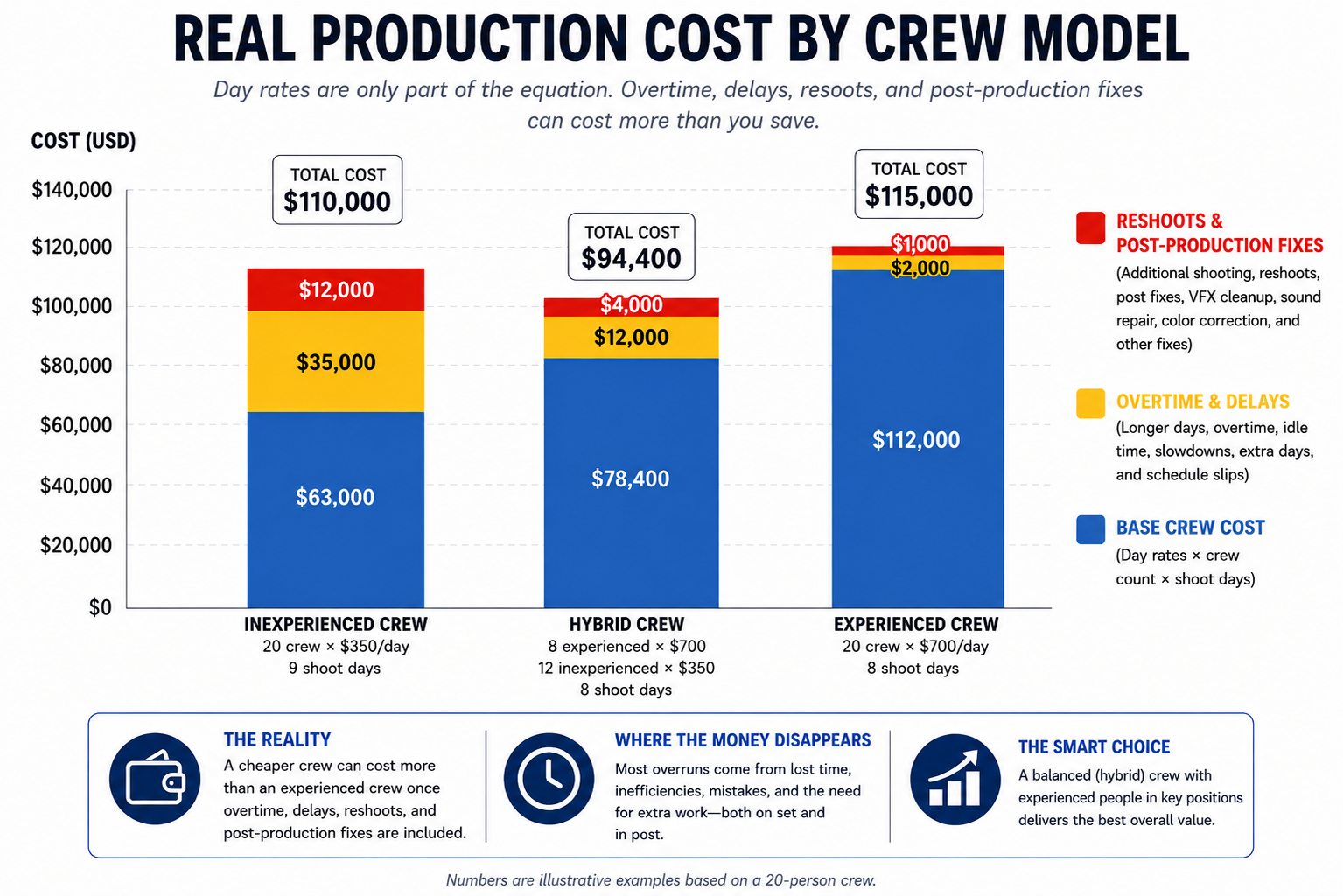
The point is not that experienced crew always costs less. The point is that the lowest day rate rarely shows the full cost of a production. Lost time, reshoots, post fixes, and avoidable mistakes can make a cheap crew much more expensive than it initially looked on paper.
- Slow crew members can create overtime
- Technical mistakes can cost valuable shooting time
- Unreliable crew can damage gear, locations, or morale
- Poor communication slows every department down
- Inexperience can create costly safety issues
- On-set mistakes can become expensive post-production fixes
- The lowest day rate is usually not the lowest production cost
What Experienced Crew Actually Protects
Experienced crew members help make the day through anticipation. They do not just handle the task in front of them. They understand what the production will need next, and they are already thinking one step ahead.
A strong crew member solves problems before the set feels them. A strong AD keeps all the departments in sync to avoid delays. A strong gaffer prevents technical delays. A strong 1st AC keeps the camera ready at all times. A strong coordinator keeps logistics from turning into chaos.
Experience also protects quality. Strong crew members make cleaner technical decisions, communicate faster, prepare earlier, and help the production spend more time on what will be seen on screen: performance, blocking, coverage, and storytelling. They do not just help the day move faster. They help the work look, sound, and feel better.
They also reduce the amount of fixes needed later. Cleaner execution on set means fewer issues in post, fewer surprises in the edit, fewer avoidable problems in sound, and fewer moments where the production has to spend money correcting something that should have been handled during the shoot.
Bottom line: a strong crew member protects the schedule, the budget, and the quality of the final film.
- Strong ADs keep the set moving
- Strong grip and electric crews prevent technical delays
- Strong camera teams allow for more usable takes
- Strong coordinators prevent logistical chaos
- A strong Art Department creates more shooting time
- A strong Production Department helps the crew do their jobs efficiently
- Experienced crew helps reduce reshoots, and post-production fixes
The Roles That Protect the Day
You do not always need an entirely experienced crew. The budget may not allow for it. But productions usually benefit from having experienced people in the positions that control pace, quality, communication, and decision-making.
The biggest schedule and quality impact usually comes from the Director, 1st AD, DP, Production Department, and department heads responsible for keeping the set moving. Their choices affect blocking, coverage, lighting, readiness, company moves, morale, overtime, and the final quality of the work.
- The Director decides when the scene has been shot
- The 1st AD keeps departments in sync and protects the pace
- The DP lights and shoots in a way that supports both schedule and quality
- The Production Department keeps logistics from slowing down the set
- Department heads make sure their teams are ready before the camera rolls
- Strong department heads gives the director and actors more takes to use in the edit
The Hybrid Crew Model
A smart low-budget production does not always need to hire the most experienced person in every position. The better approach is often a hybrid crew: experienced people in the positions that control pace and quality, with newer or lower-cost crew in positions where the risk is lower.
That model gives newer crew a chance to gain experience from seasoned crew members while still protecting the production from unnecessary delays, confusion, overtime, reshoots, and quality loss.
A hybrid crew can be cheaper than an all-inexperienced crew once overtime, mistakes, lost time, stress, reshoots, compromises, and post-production fixes are factored in.
- Experienced key positions can reduce overtime
- Newer crew members can perform well with proper leadership
- Strong department heads help less experienced crew make better decisions
- A hybrid crew can often protect the schedule without paying top rates in every position
- Experienced department heads helps protect the look, sound, and consistency of the project
- The goal is not the cheapest crew; the goal is balancing quality, time, and budget
Quality Is Part of the Budget
Quality is not separate from cost. On set, quality is often created by time, focus, preparation, and experience. When a crew is constantly catching up, fixing mistakes, or waiting on basic decisions, the production loses the time needed to actually shoot the movie.
That can show up in small ways: rushed lighting setups, weaker blocking, missing props, poor communication, messy handoffs, bad sound, soft focus, unfinished sets, or fewer takes for performance. None of those problems may look dramatic in the moment, but together they affect the final project.
Those issues also create a hidden cost after the shoot. A rushed set can become a more expensive edit. Bad sound needs cleanup. Missed details can become VFX work. Soft focus, poor continuity, missing inserts, and incomplete coverage can limit the choices available for the edit.
Experienced crew members help protect quality because they know what matters and what does not. They know when to move quickly, when to slow down, when to speak up, and when a small fix now will save a bigger problem later.
- Better preparation creates cleaner shoot days
- Fewer mistakes means more time for what goes on screen
- Experienced crew helps prevent quality from slipping under pressure
- Strong on set decisions reduce costly fixes later
- Cleaner work on set gives post-production more options
- More usable shooting time usually leads to a stronger final result
Respect Is Part of the Math
Experienced crew also expect production to understand basic production customs. That includes turnaround, meal penalties, overtime, portal-to-portal for drivers, payment terms, deal memos, proper communication, and safety expectations.
If production avoids those conversations or ignores the conditions crew work under, experienced crew will notice. Fixed day rates that ignore overtime can create distrust if the crew feels production is trying to get more work without paying properly.
- Be clear about pay
- Be clear about overtime
- Be clear about payment timing
- Respect turnaround and meal rules
- Do not hide hard days from the crew
- Do not expect loyalty from a crew that feels used
Why Crew Trust Matters
Cast and crew quickly understand whether production has their interests in mind or only cares about the schedule, the client, or the final product.
A crew that feels respected, fed, paid, informed, and treated fairly is more likely to push for the show. A crew that feels ignored, underpaid, or misled will start protecting itself.
- Respect keeps morale up
- Clear communication keeps people from guessing
- Fair pay practices build trust
- Food and basic crew care affect pace
- Good crew comes back when production treats them correctly
- Consistent crew makes future productions easier to run
The Real Production Lesson
Cheap crew becomes expensive when production starts paying for the consequences: overtime, delays, reshoots, post-production fixes, missed opportunities, and reduced quality. The real question is not who has the lowest rate. The real question is who creates the most value for the production.
Good producers spend strategically in the positions that protect the pace and the quality: Director, 1st AD, DP, art, sound, production, and other roles that help the day run smoothly and efficiently.
The cheapest day rate is rarely the cheapest production. Time lost to mistakes, delays, overtime, reshoots, and post-production fixes often costs more than hiring the right person from the start.
Will this person's experience earn back their higher rate through fewer mistakes, less overtime, fewer fixes, and a better final result?